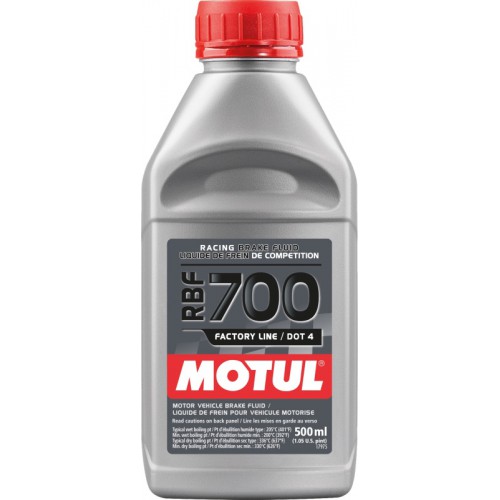
Motul RBF 700 Factory Line DOT 4 – Synthetic Racing Brake Fluid
Check part compatibility
Motul RBF 700 Factory Line – Synthetic DOT 4 Racing Brake Fluid
Motul RBF 700 Factory Line is a top-tier, 100% synthetic DOT 4 brake fluid engineered for extreme motorsport conditions. With an exceptional dry boiling point of 336 °C and a wet boiling point of 205 °C, it delivers consistent pedal feel and pressure stability during long stints, repeated heavy braking and high-temperature operation on steel, carbon or ceramic brake systems.
Key Advantages
- Extreme boiling resistance: 336 °C (dry) / 205 °C (wet) reduces vapor lock and fade in endurance racing.
- Stable viscosity and compressibility: precise ABS/ESP modulation even when brakes run hot.
- Motorsport-focused formulation: ideal for GT, time-attack, drift and pro-level competition.
- System compatibility: usable in hydraulic brake and clutch systems requiring DOT 3/4/5.1 performance (do not mix with DOT 5 silicone or mineral LHM).
- Chemical stability: robust resistance to moisture uptake helps maintain performance over time.
Applications – Track, Endurance and JDM Performance
Recommended for performance-oriented Japanese cars such as Honda Civic Type R, Integra DC5, S2000, Subaru WRX/STI, Mitsubishi Lancer Evolution and Nissan 370Z. Perfect for track days, sprint/time-attack and endurance where thermal headroom and repeatability are critical.
Technical Specifications (Motul Official)
- Standards: FMVSS 116 DOT 4 / SAE J1703 / SAE J1704
- Dry boiling point: 336 °C / 637 °F
- Wet boiling point: 205 °C / 401 °F
- Kinematic viscosity @ 100 °C: 2.63 mm²/s
- Kinematic viscosity @ −40 °C: 1 757 mm²/s
- Type / color: synthetic polyglycol, amber
Comparison: Motul RBF 700 vs RBF 660
| Parameter | RBF 700 | RBF 660 | Takeaway |
|---|---|---|---|
| Dry boiling point | 336 °C | 325 °C | RBF 700 offers more thermal headroom for endurance racing. |
| Wet boiling point | 205 °C | 205 °C | Identical wet rating – both remain stable after moisture uptake. |
| Typical use | Pro motorsport, GT, endurance | Track days, sprint/time-attack | Choose 700 for full-race duty; 660 suits most track builds. |
FAQ – Common Questions about Motul RBF 700
What’s the difference between RBF 700 and RBF 660?
RBF 700 has a higher dry boiling point (336 °C vs 325 °C) and is tuned for longer stints and pro racing. Both share the same 205 °C wet boiling point.
Is RBF 700 suitable for street use?
Yes. It meets DOT 4 and works with ABS/ESP. Its benefits are most noticeable in high-heat, track-focused setups.
How often should RBF 700 be replaced?
For track cars: every 6–12 months or after each racing season. Polyglycol fluids absorb moisture over time, lowering the wet boiling point.
Can I mix RBF 700 with other fluids?
Compatible with polyglycol DOT 3/4/5.1 fluids, but for maximum performance perform a full system flush and refill with RBF 700 only. Do not mix with DOT 5 (silicone) or mineral LHM.
Is RBF 700 compatible with ABS and ESP?
Yes. Its viscosity and compressibility characteristics support precise pressure control in modern ABS/ESP systems even at elevated temperatures.