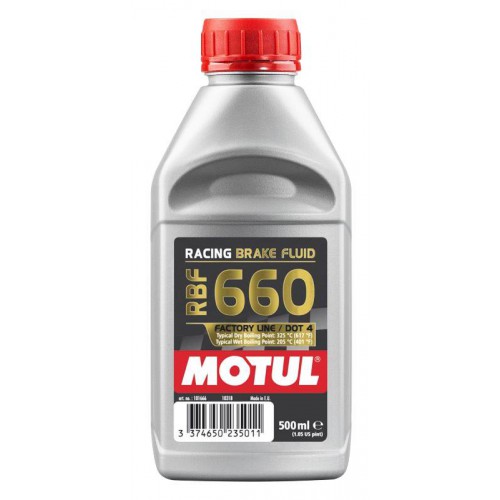
Motul RBF 660 Factory Line – DOT 4 Synthetic Racing Brake Fluid for Track and Motorsport
Check part compatibility
Motul RBF 660 Factory Line – DOT 4 Synthetic Racing Brake Fluid for Track and Motorsport
Motul RBF 660 Factory Line is a 100% synthetic DOT 4 brake fluid engineered for extreme motorsport conditions – long stints, high brake temperatures, carbon or ceramic rotors and aggressive cooling setups. Its exceptionally high dry boiling point of 325 °C / 617 °F and wet boiling point of 205 °C / 401 °F ensure consistent braking and pedal feel during intense and repeated braking phases.
Key Advantages
- Maximum thermal stability: 325 °C (dry) / 205 °C (wet) minimizes vapor-lock and brake fade during long stints and endurance racing.
- Stable performance in humid environments: maintains efficiency even after moisture absorption (~3 % H2O), representing one year of real-world use.
- Track-focused formulation: designed for systems exposed to extreme heat, including carbon and ceramic brakes; helps reduce the need for cooling air scoops, improving aerodynamics.
- Full system compatibility: suitable for hydraulic brake and clutch systems, including modern ABS / ESP setups.
Applications – Motorsport, Endurance and JDM Performance
Ideal for performance-oriented Japanese and racing cars such as Honda (Civic Type R, Integra, S2000), Subaru (Impreza WRX / STI, BRZ), Mitsubishi (Lancer Evolution), and Nissan (370Z, GT-R clutch hydraulics). Perfect for time-attack, endurance and sprint racing, and for high-performance street/track builds requiring stable braking under repeated high loads.
Technical Specifications (Motul Official Data)
- Standard / Specification: FMVSS 116 DOT 4; SAE J1703 / J1704
- Dry boiling point: 325 °C / 617 °F
- Wet boiling point: 205 °C / 401 °F
- Kinematic viscosity @ 100 °C: 2.6 mm²/s
- Kinematic viscosity @ −40 °C: 1 698 mm²/s
- Type: 100 % synthetic polyglycol, non-silicone – amber color
RBF 660 exceeds DOT 3 and DOT 5.1 standards in boiling performance; only viscosity at −40 °C falls outside DOT 5.1 spec.
Comparison: Motul RBF 660 vs RBF 600
| Parameter | RBF 660 | RBF 600 | Real-world takeaway |
|---|---|---|---|
| Dry boiling point | 325 °C | 312 °C | 660 offers extra headroom for long stints and carbon / ceramic brakes. |
| Wet boiling point | 205 °C | 205 °C | Identical – both maintain excellent wet resistance. |
| Viscosity @ 100 °C | 2.6 mm²/s | 2.5 mm²/s | Almost identical; both stable at high temps. |
| Viscosity @ −40 °C | 1 698 mm²/s | 1 750 mm²/s | 660 flows slightly easier in cold weather. |
| Typical use | Racing / endurance / long stints / carbon brakes | Track day / fast road / sport driving | RBF 600 fits most street & track cars; RBF 660 is for pure race setups. |
Usage & Compatibility
- Change interval: follow vehicle-manufacturer guidance; under track conditions replace every 6–12 months (or sooner under heavy use).
- Mixing: do not mix with DOT 5 (silicone) or LHM (mineral) fluids. Mix only with high-grade DOT 4 synthetic fluids if needed – for best performance, flush the system completely.
- Storage: keep sealed in original container; fluid is hygroscopic and absorbs moisture from air.
FAQ – Common Questions about Motul RBF 660
What is the difference between Motul RBF 660 and RBF 600?
RBF 660 has a higher dry boiling point (325 °C vs 312 °C) and is optimized for longer stints and carbon / ceramic brakes. Both share the same wet boiling point of 205 °C.
Is RBF 660 suitable for street use?
Yes – it’s a DOT 4 fluid fully compatible with ABS / ESP systems. However, its full potential is achieved under track and competition conditions.
How often should RBF 660 be changed?
Replace every 6–12 months for track or performance use. DOT 3 / 4 / 5.1 fluids are hygroscopic – moisture lowers the wet boiling point over time.
Can RBF 660 be mixed with other fluids?
Avoid mixing with lower-performance products. Do not mix with DOT 5 (silicone) or LHM (mineral). Best results come from a complete flush and refill.
Is RBF 660 compatible with ABS and ESP systems?
Yes – its stable viscosity and compressibility make it ideal for modern braking systems that require precise pressure control under heat.